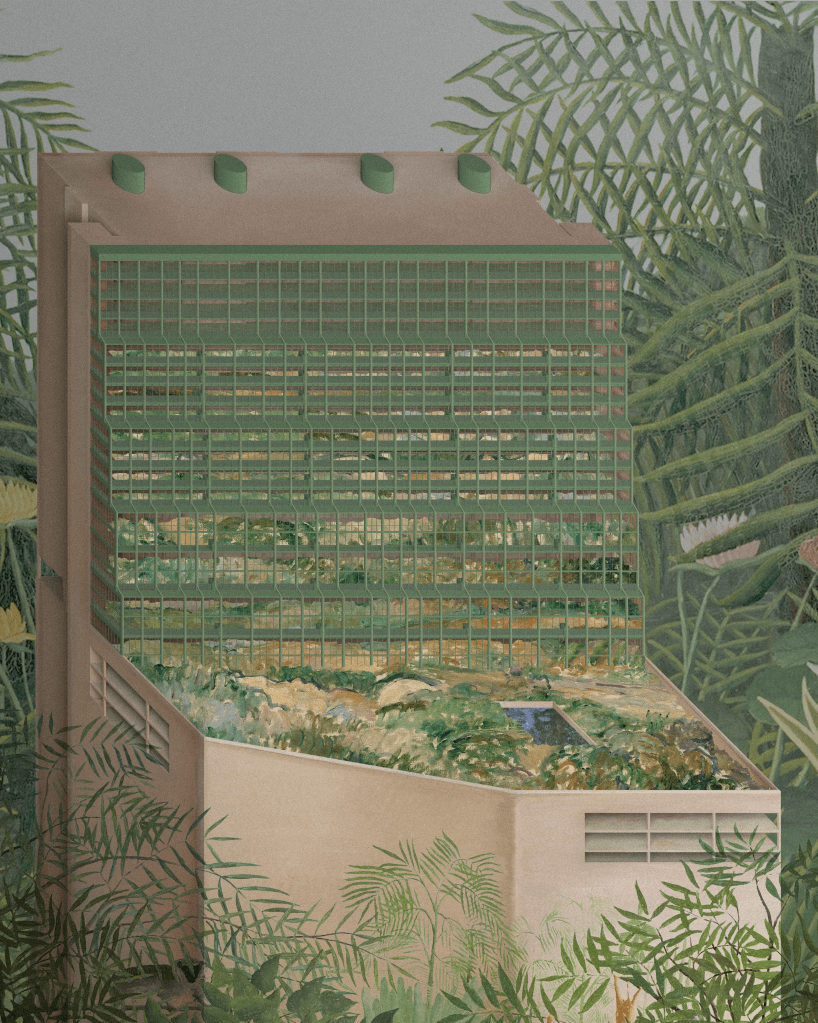
In The Story of the Stone, a multi-volume Chinese Novel from the 18th Century, six children and one young woman settle in a garden. The relationship between the children and the garden is described as symbiotic: the garden lends its beauty to their education, while with their beauty they inspire the garden’s growth. There are groups of six children living in the residential tower by Fresh Pond. Our proposal asks: how can children weave communities together in ways we could not anticipate? How might an architectural intervention create an infrastructure for their mental lives, for their emotional growth, for their social curiosity?
The plan is predicated on a system of mutual aid. There are nineteen floors. Each floor contains eight apartments. Apartments on each floor are grouped in societies of two. Each society shares a water tank and a society of six children. Gardens in the addition are allocated one per apartment and are bounded as their caretakers see fit. It begins with the children’s room: a garden where humanS walk on carpeted floors and grow, slowly. The children’s room is bounded on all sides by the existing building fabric. But the solidity of walls cannot stop children. A door appears in the wall between two children’s rooms, allowing children to pass freely from one apartment to another. Adults cannot use this door. Even to check on their neighbours’ children, they must enter through the front door. They must knock.
The apartments are planned so that adults in each society can supplement each other’s childcare and garden care needs. Children’s rooms and water tanks infrastructurally connect the units in each pair. A child may lie down on the floor in the children’s room, and look out over all the floors, right through to the addition and its carpet of grass. As the gaze travels northeast, the apartment becomes a succession of organisms at different scales, of walls at different heights. In the bathroom, partitions hang two feet below the ceiling, providing clearance for the upstairs neighbours’ pipe. This pipe channels greywater through the whole apartment to the tank in the addition, where it is filtered and stored for use as irrigation. In the kitchen, floors are slippery, and moss may grow amongst the tiles. The living room is separated from the kitchen by a low fence. Those who wish may accommodate this room to the needs of growing plants. A layer of substrate may be unfurled over the floor.
The addition is a vertical garden bounded by glass. When it rains, water clings to the glass and makes a curtain. When it snows, the plants in the garden are still green.
On the ground floor, a water treatment facility processes excess greywater from the addition. Treated water travels in underground pipes to the walled garden, where it will be reused. An existing, underused carpark sprouts trees, toilets, and staircases. A library is inserted on the periphery and becomes overgrown. Historically, garden has the function of treating effluence. Rather than imposing more need for water, garden additions in proposal can sustain only on abundant rainwater and grey water. A system of purification, irrigation, and redirection is key to the sustaining and garden. The garden collects the weather and keeps it. Today it collects water and stores it, in plants, in tanks. Tomorrow it may collect sun, snow, or wind. It collects time spent, time given, time lived within its boundary.
the garden is a tiny replica of Fresh Pond, going beyond its function as a water purification infrastructure, to offer educational and recreational functions back to the city. The walled garden contains plants selected from Fresh Pond. Trees and shrubs are arranged in societies of their own, that their needs might complement one another. The walled garden changes colour in every season and is enclosed to collect all traces of the passage of time.
The addition is a parasite structure. But rather than taking from the old building, it reorganizes and gives back to it. It is simultaneously a circulation system, a thermal insulation, and a living infrastructure for the purification of wastewater. The addition extracts the existing circulation cores and reorients them, so that each apartment is accessed through the garden. The addition is divided into five stepping sections, allowing rainwater to slide down from section to section, lowering the curtain. The shape also creates different sizes of garden, responding to varying needs. There are people at the top who grow cacti in pots, and people at the bottom who grow trees.
 Leon Fong
Leave a comment